During the 1960s, Riyadh was undergoing an accelerated urban transformation, shifting from traditional building practices toward modern architecture characterized by reinforced concrete, vertical expansion, and a reconfiguration of the relationship between buildings and streets. The Al-Malaz district, whose development began in the 1950s, was one of the principal sites of this transformation.
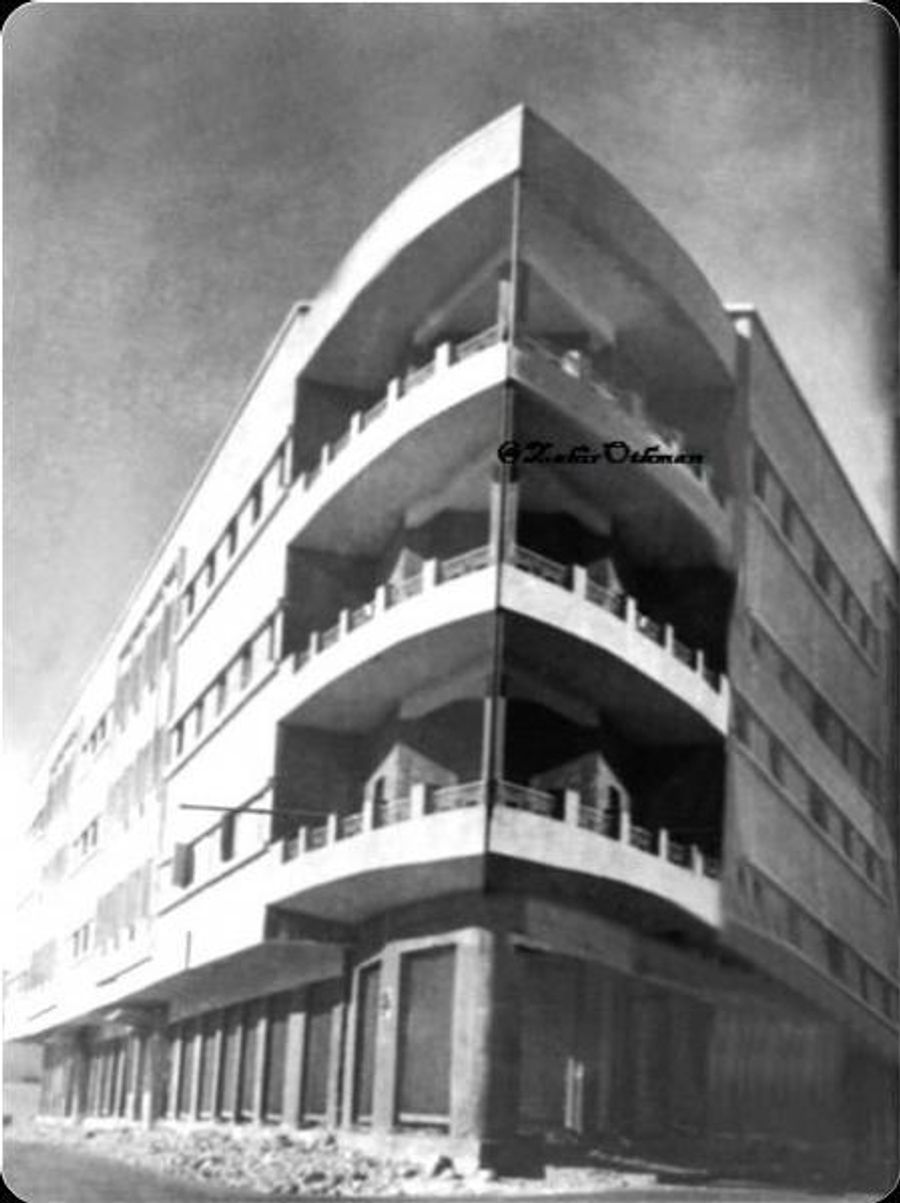 Archival Photograph of the Ship Building
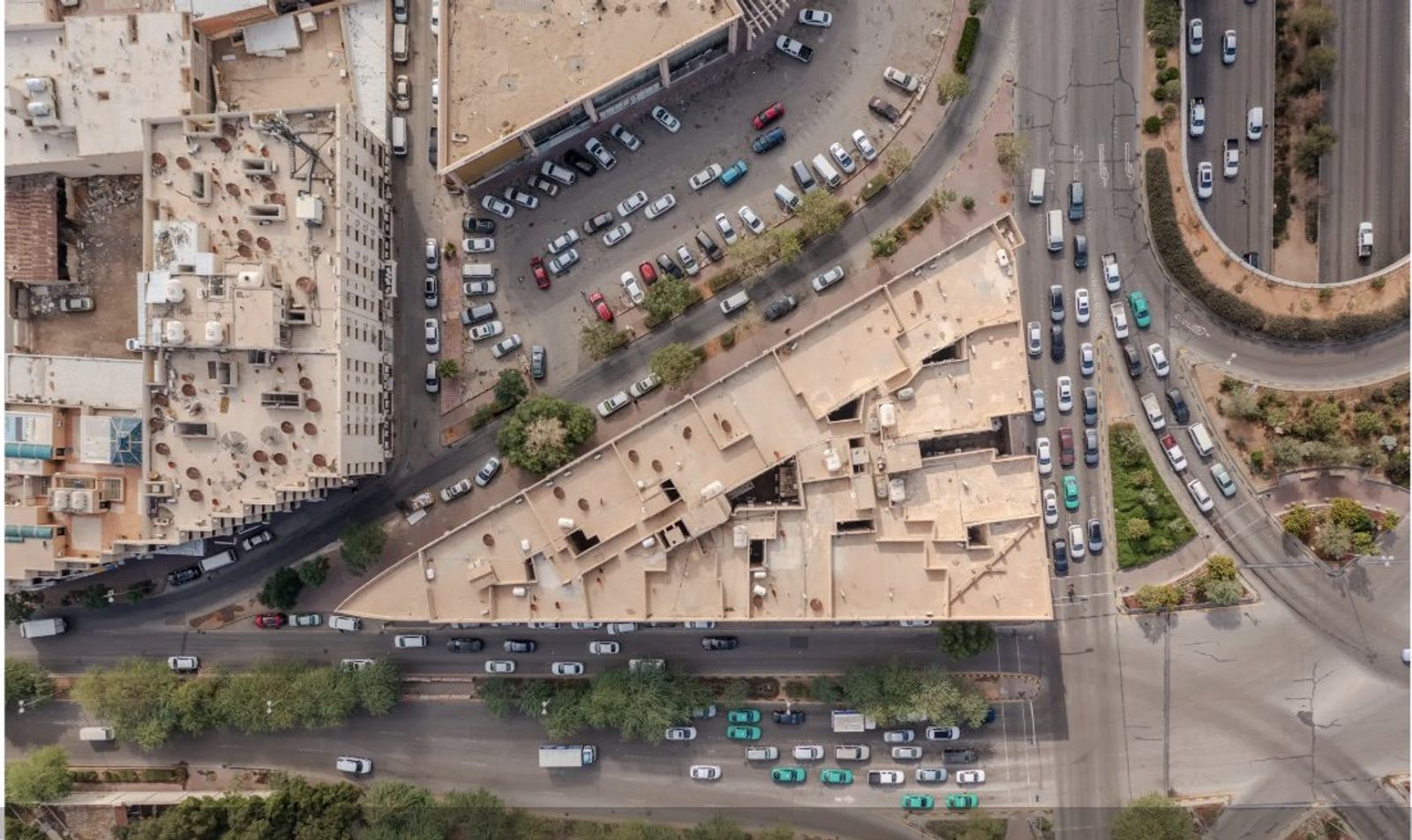 Satellite Image of the Ship Building
The Egyptian architect Sayed Karim, one of the pioneers of modern architecture in Egypt, emerged as a significant figure in this process, alongside the Arab Contractors Company, within networks of engineering expertise and construction that contributed to shaping the Saudi capital’s new urban landscape, influenced by Cairo and its political and social conditions. It was in this context that the “Ship Building” appeared in 1966 on Al-Khazzan Street, followed by the “Barrel Building” in Al-Malaz during the same decade. Both represented notable experiments in the early history of architectural modernity in a city still searching for its identity.
The Ship Building was constructed on land reportedly owned by Princess Sita bint Saud bin Abdulaziz. Construction was undertaken by Mustafa and Ahmed Hijazi, although I have been unable to identify its architect. The building takes on a wedge-shaped form that responds to the geometry of its triangular plot. Its elongated façade unfolds through a repetitive rhythm of windows and projecting concrete elements before tapering toward a narrow end, producing a form reminiscent of a ship’s bow. The building accommodated residential units and medical clinics, becoming part of the city’s everyday life and visual memory rather than merely a formal landmark within its urban landscape.
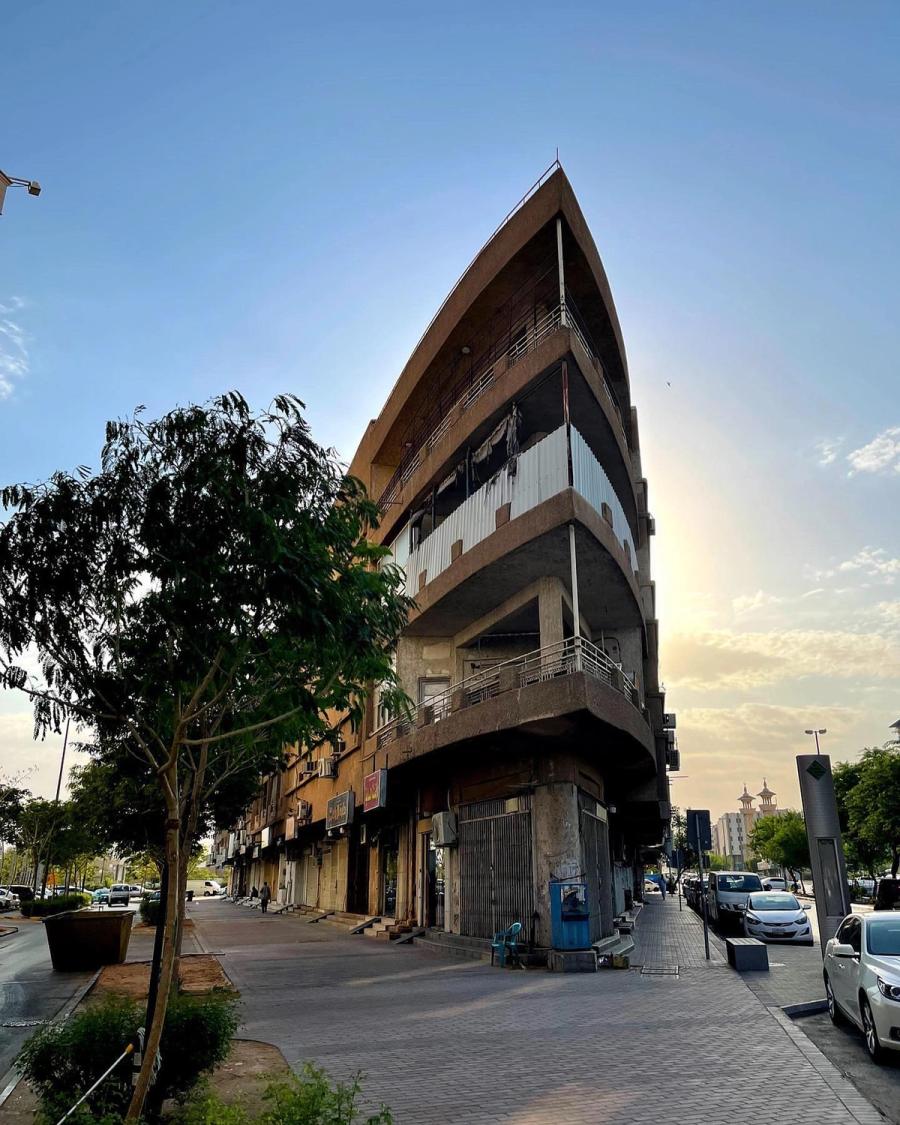 صورة حديثة لعمارة الباخرة
The Barrel Building belongs to the same period of urban expansion. Its construction is attributed to the Egyptian Arab Contractors Company, associated with the engineer and contractor Osman Ahmed Osman. Sayed Karim’s involvement in architectural projects in Riyadh during this period allows us to situate the building within a broader context of architectural knowledge and expertise circulating between Cairo and Riyadh, although sufficient evidence is not available to attribute its design directly to him. The building consists of a cylindrical volume wrapped in continuous horizontal bands punctuated by window openings and crowned by an open circular structure at roof level. Between the Ship Building’s wedge-shaped extension and the Barrel Building’s circular configuration, we can identify two distinct attempts to explore the geometric possibilities of modern architecture beyond conventional rectangular forms.
Neither experiment can be separated from the broader history of architectural modernity in the region. Through Arab architects, engineers, and contractors, reinforced-concrete construction techniques and modernist architectural vocabularies that had already been explored in cities such as Cairo, Alexandria, and Baghdad made their way to Riyadh. Yet the circulation of these forms of expertise was not simply a matter of reproducing ready-made architectural models. Rather, the conditions of the land, building functions, patterns of investment, and social life in Riyadh reshaped these vocabularies, producing architectural expressions particular to the city. From this perspective, the trajectories of Sayed Karim and the Arab Contractors Company become part of a wider history of the circulation of knowledge and architecture between Arab cities, rather than merely names associated with a particular phase of construction or a specific political authority.
What deserves reflection in these two architectural examples, however, extends beyond their formal configurations or the identities of those responsible for their construction. Both entered the city’s collective memory through an architectural and urban orientation associated with the middle class in an urban district that contributed to the formation of modernity in Saudi Arabia. This tendency can be traced across numerous examples of architectural design and urban planning in these areas, which provided spaces for social interaction within the city. Such spaces were subsequently eroded with the ascendancy of a more rigid religious discourse following the 1979 Grand Mosque seizure led by Juhayman al-Otaybi, and its consequences for urban and architectural space.
Today, while the Ship Building remains part of Riyadh’s urban landscape, the Barrel Building has disappeared following its demolition, surviving only in photographs and memory. Between persistence and disappearance, the two buildings reveal an aspect of Riyadh’s architectural modernity that was shaped not only by major development projects but also by residential and commercial buildings that accommodated transformations in everyday life. They witnessed a moment when the city was searching for new forms of dwelling, movement, and inhabiting space. Perhaps the paradox is that what once represented the future has now become part of the city’s past, and of an architectural memory increasingly eroded with every disappearing building, alongside an urban identity increasingly imposed by neoliberal and consumerist policies.a