What if the history of modern surveillance did not begin with the prison, the camera, the hospital, or the apparatuses of the modern state, as the French philosopher Michel Foucault insists, but rather with the body? And what if modernity, which certain strands of scholarship have long associated with rationality, emancipation, and technological progress, had developed some of its instruments of knowledge and organization through a prolonged history of subjugating, classifying, and controlling the movement of bodies?
In her 2015 book “Dark Matters: On the Surveillance of Blackness”, Simone Browne rethinks the history of surveillance from the standpoint of slavery, racism, and colonialism. She does not seek merely to insert Black people into the established narrative of modern surveillance, but to interrogate the very foundations upon which that narrative rests. Surveillance, in her account, is a historical practice that has participated in producing racial difference and determining who possesses the right to move, to appear, and to disappear. It is from this paradox that surveillance derives its force.
Browne confronts us with the limits of the Foucauldian reading of disciplinary power, a reading whose modernist centrism persists even in its critique of modernity. Rather than beginning with the Panopticon, she turns to the slave ship, property registers, the branding of bodies, and the laws that regulated Black movement through colonial space. The slave ship does not simply replace the prison; that is hardly the point. Rather, it becomes a means of interrogating a history of modernity that positioned European institutions at the center of our understanding of power, and that made even their critique another exercise in reproducing their epistemological centrality. Meanwhile, slavery and colonialism remained at the margins of modernity's theoretical formation. At the same time, this history rendered us blind to the forms of knowledge emerging from these sites, dismissing them as premodern.
Here lies one of the book's most fundamental contributions: surveillance does not merely observe difference; it participates in producing it. Through the concept of “racializing surveillance”, Browne reveals how Black bodies become objects of classification and suspicion, and how knowledge about them is transformed into a means of managing their movement, exploiting them, and rendering them quantifiable. In the diagram of the slave ship, the body becomes a measurable unit, distributed within a confined space. Violence here does not appear as the opposite of rationality. Rather, it operates from within rationality itself: through calculation, organization, and the transformation of the human being into an object of knowledge and property, within a process that is at once operational and instrumental!
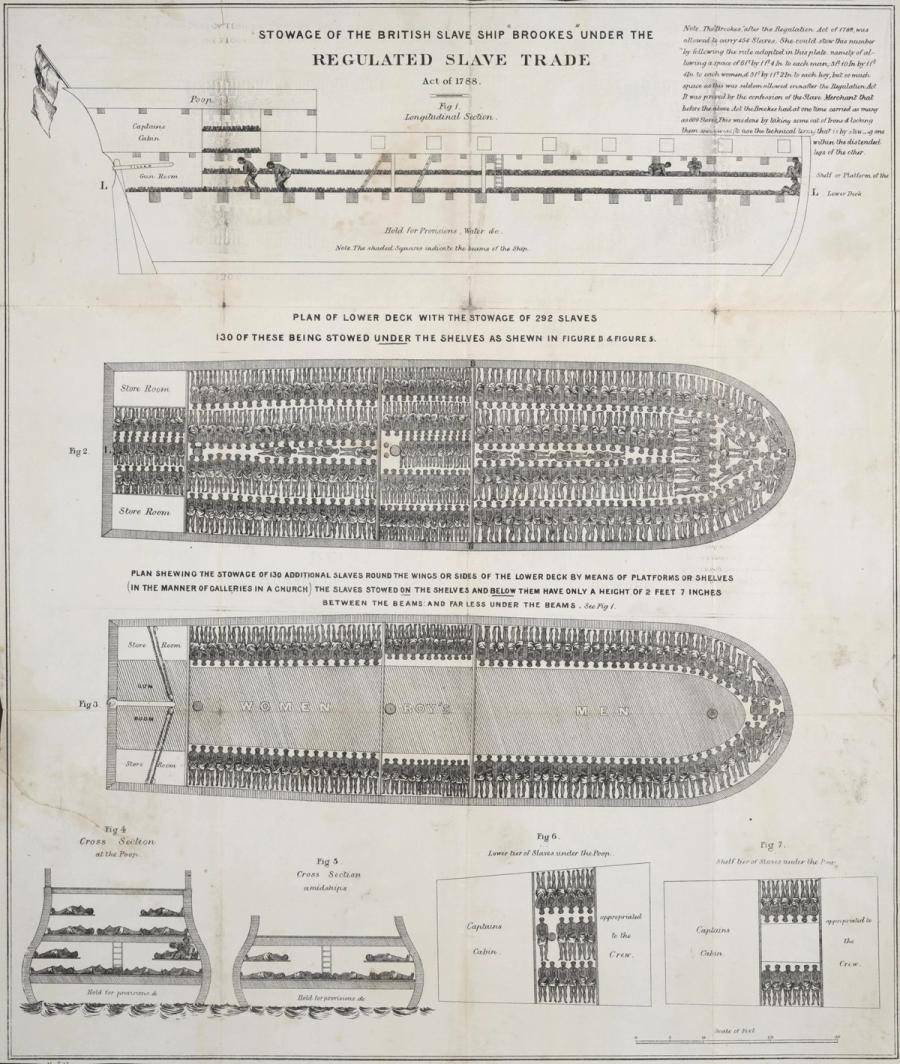 Plan of the stowage of enslaved people aboard the British ship “Brookes,” as cited by Simone Browne, p. 46. Image source: Wikimedia Commons, public domain.
Such a relationship is hardly distant from our present, if we consider our contemporary spaces and cities. In New York, for example, Amnesty International's research in 2022 revealed a greater concentration of surveillance cameras compatible with facial recognition technologies in neighborhoods with higher proportions of non-white residents, particularly in parts of the Bronx, Brooklyn, and Queens. The neighborhoods most exposed to this technological infrastructure were also those that had experienced higher levels of police stop-and-frisk practices. This relationship demonstrates that technology produces racism, but it also reveals how new instruments of visibility can be introduced into a geography already structured by discrimination.
The paradox becomes even more glaring in the case of Robert Williams, a Black man arrested by Detroit police in 2020 following a technological error in facial recognition. The problem was not merely a technical failure in matching images, but the transformation of an unreliable algorithmic result into a police action that deprived a human being of his freedom. Here, we can read Browne beyond an explanation that reduces the problem to algorithmic accuracy: even when accuracy improves, the question remains one of the institutions deploying the technology, the bodies subjected to it, and the authority that grants digital outputs the status of evidence.
Among the book's most thought-provoking moments is Browne's reading of the lantern laws in colonial New York, which required Black people and enslaved persons, under certain circumstances, to carry a source of light when moving at night. Light was not an instrument of liberation from darkness, but a means of compelling the body into perpetual visibility, of marking it through its exposure to authority. Infrastructure itself -illumination becomes both the medium and the mark of this imposed exposure! Browne reveals that the right to be visible is fundamentally different from being compelled to appear.
Browne introduces the concept of “dark sousveillance” to examine the practices Black people developed to confront, evade, and repurpose systems of surveillance. In our present, we might consider the documentation of police violence, and the recordings made by ordinary citizens that have rendered certain forms of racial violence visible to a wider public, as practices that raise the same question: who possesses the right to produce an image and determine its meaning? Here, the possibilities of emancipation do not lie simply in reversing the direction of the gaze, but in interrogating the relations and institutions that subject certain bodies to continuous visibility and exposure.
These questions allow us to rethink the modern city, not merely as an architectural achievement of modernity, but as an intellectual and material model for organizing society. The straight street, the open square, the land registry, functional zoning, and transportation networks are all instruments through which technical knowledge intersects with the state's and capital's conceptions of order, productivity, and security. Here, we add another layer to the contributions of white theorists such as Henri Lefebvre and David Harvey. For them, the city is a space for the reproduction of social and capitalist relations, while Browne introduces another question: which body can inhabit and use this space without its very presence becoming an object of suspicion?
Yet we must resist the temptation to turn these different examples into a single history of surveillance. Anti-Black racism in the United States, the security regulation of public space in Cairo, privatization in Beirut, and settler colonialism in Palestine are not identical phenomena. Browne's value lies not in erasing these differences, but in providing us with questions through which to examine how social classifications intersect with the instruments of visibility, organization, and power.
And if we were to extend Browne's thesis along its own lines into our Arab cities, we would find that the question goes beyond exposing relations of domination within the city. It also requires interrogating the very instruments through which we produce knowledge about it. A map depicting a continuous road may tell us nothing about the body prohibited from crossing it. An aerial image counting destroyed buildings cannot, on its own, represent the social relations and memories that disappeared with them.
From here, we might pose the question anew to the modern city: does its freedom lie in becoming more transparent, more manageable, and more readily appropriated, or in its inhabitants possessing the capacity to produce their lives beyond the conditions imposed upon them by systems of surveillance, property, and control?
Perhaps the city we ought to imagine is not one capable of seeing everything, but one in which its inhabitants are no longer compelled to prove their right to exist each time they step outside their homes.
(Peace upon Cairo, Amman, Beirut, Jaffa, Jerusalem, Gaza and all the other Arab cities)