
Politics of Desire in Palestinian Cinema: An Intersectional Anti-Colonial Approach
Translated by: Hiba Moustafa
How can desire serve as a lens to understand the politics of representation, erasure, and discourse in Palestinian cinema, within its colonial context [1] and in the face of Israeli policies of erasure?
Over the past five decades, Palestinian filmmakers have used their tools – and likewise, agency – to explore their longing for homeland, as a simultaneously individual and collective emotion.
In this context, desire, broadly understood, has served as one of the vehicles for conveying these emotions and ideas. [2] This article delves into politics of desire in Palestinian cinema by examining the manifestations and representations of necropolitics and gender in cinematic visual materials and their interpretations, employing an anti-colonial sense to understand them.
Through critical reflection on films – including Wedding in Galilee (Khleifa, 1987), Rana's Wedding (Abu-Asad, 2002), Paradise Now (Abu-Assad, 2005), Salt of this Sea (Jacir, 2008), and When I Saw You (Jacir, 2012), Amira (Diab, 2021), and It Must Be Heaven (Suleiman, 2021) – the below explores how desire functions as a site of resistance and challenge to dominant narratives and their entanglements, positioning desire as a radical component that asserts resistance, the right to exist, to meaning, and to imagination.
ORIGINS
The word desire, from the Latin root desiderare, refers to “a state of sorrow resulting from losing a subject, or a state of spontaneous and conscious inclination towards the subject we conceive.” [3]
Al-maany dictionary defines it as “a spontaneous, conscious drive towards a specific goal.” In both, the self and desire are governed by a negative relationship, one essentially determined by linking the self to a sense of lack. The presence of the subject is a necessary condition for desire to arise, but the presence is “presence in absence.” Thus, desire is a trace of something in absence; it is fundamentally rooted in the unconscious and consequently represents a state of inscription in absence.
In Psychoanalysis, Catherine Clément argues that the essence of the unconscious lies in temporal discontinuities, and its primary function is repression — that is, to keep drives that seem to generate the opposite of pleasure in certain regions of the unconscious. [4]
The nucleus of the unconscious consists of the elements representing the basic impulse (i.e., the trace), which strive to release their contents through desire and its manifestations. [5] These impulses can no longer be directly expressed except through dramatization in the form of a dream, illusion, myth, and so on. [6]
What matters here is that the unconscious remains a fundamental condition for each and every individual and collective history. Although it encompasses the history of individual life, the unconscious continues to witness history that circulates through the structures of the collective. [7]
Accordingly, the politics of desire in Palestinian cinema go beyond romantic longing for a lover. They include a complex interaction that extends from personal bodily longing to the pores and boundaries of the collective, and even to the corporeality of geography.
These interactions are subject to continuous processes of production through occupation, killing, displacement, genocide, and various forms of biopolitics, which shape, reshape, and perpetuate trauma. [8]
Through film – as an expressive medium that bridges the public and the personal, the individual and the collective – Palestinian directors express a spectrum of desires and the collective unconscious that challenge narratives of domination and assert agency in the face of colonial erasure.
THE DESIRE TO SEE AS REVELATION AND TEMPORAL EXISTENCE
Since its inception, Palestinian cinema has been driven mainly by a desire for vision and self-representation, which Edward Said called “permission to narrate,” a right enacted by the Palestine Film Unit (PFU) of the Palestine Liberation Organization (PLO), established in 1968. [9]
Elia Suleiman’s films – including It Must Be Heaven (2021) – dismantle orientalist tropes through archival materials, or what is referred to as the “archival body.”
A contemporary critical concept used in film and culture studies, the term refers to the human body as a signifier of memory, desire, and collective experiences, a living archive that disrupts linear time by inscribing past events through its lived experience.
The body bears the marks of wound, exile, loss, and erasure, becoming a sign that the event, though politically over, is not historically concluded. The body, therefore, becomes a tool of resistance against attempts at visual and narrative elimination and exclusion. [10]
Desire, then, has its own archive, simultaneously inscribed in individual and collective bodily existence. It is a space where collective memories intersect with personal experiences, and where the presence of the absent, stolen, or lost reconstructs the Palestinian narrative through physical presence in film. [11]
Suleiman’s films reflect what Homi K. Bhabha called “The Third Space”, [12] where hybrid identities undermine binary oppositions between the colonizer and colonized. Here, desire becomes a means of resistance through the collective urge to be seen, heard, felt, and desired, without erasing the political implications of such acts.
The desire felt by the Palestinian body – as not just individual but collective – reflects, in a way, what Benedict Anderson conceptualizes as “imagined communities” (1983).
In Michel Khleifi’s Wedding in Galilee, a traditional wedding must be held under the gaze of Israeli military officers. The rituals of socially structured desire become a performance of resistance, without denying the audience the intimate, individual expressions of desire between the couple. [13]
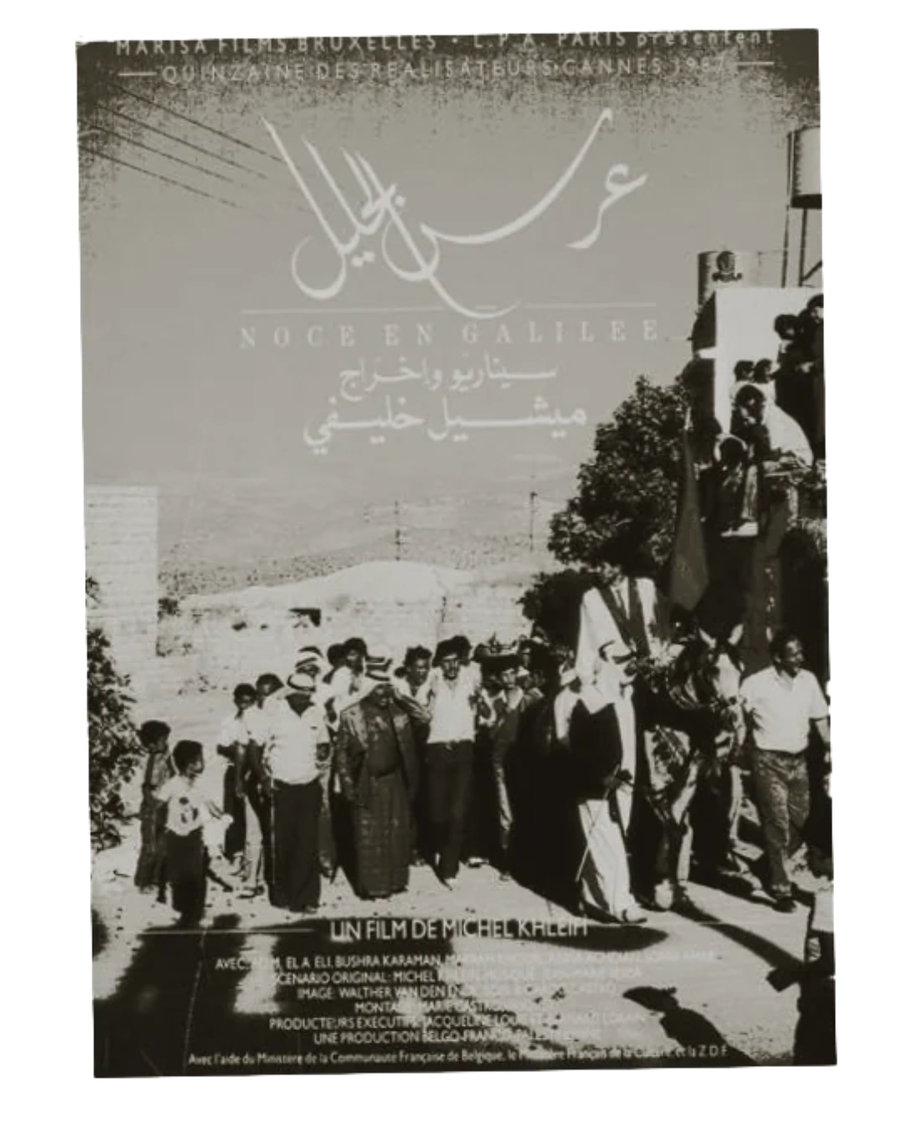
The film takes place in a Palestinian village following the 1948 Nakba, where the village mukhtar (Abu Adel) wants to celebrate his son’s wedding in the traditional way, despite a curfew imposed by the Israeli authorities.
The Israeli military governor permits the wedding on the condition that he and his staff attend the ceremony. Within this temporal fusion of the time of the wedding and the time of the curfew, and between the traditions of Christian and Islamic weddings, Khleifi blurs time and place without disrupting the conventional structure of the wedding.
This extends the boundaries of the Palestinian people through shared performative acts, even if such performances were granted under a military exception.
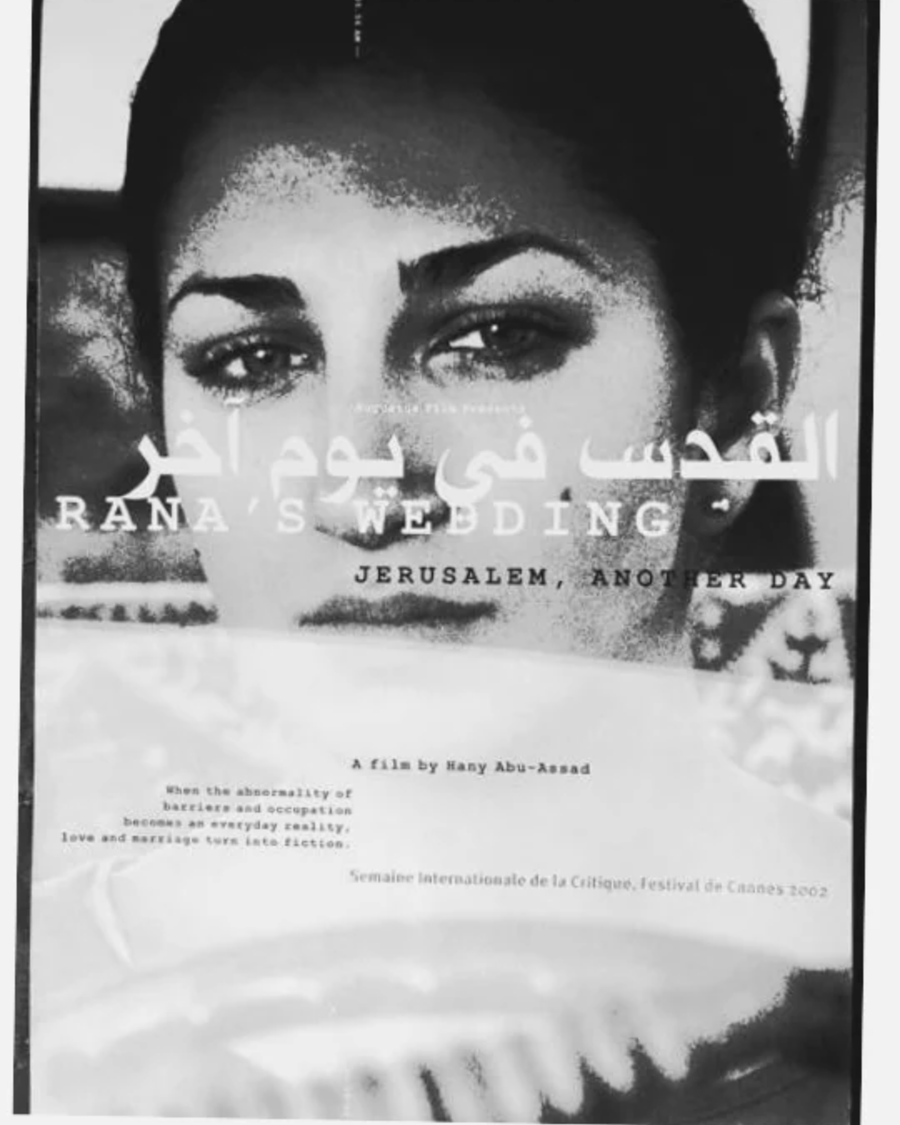
RANA'S WEDDING (2002)
Hany Abu-Assad’s Rana's Wedding provides another model for analyzing manifestations of desire in the Palestinian colonial context.
Rana embodies a desiring subject that seeks to realize her emotional desire by marrying the one she loves within a dual system of oppression: colonial (represented by checkpoints and military control) and patriarchal (represented by the father’s authority).
Here, desire is no longer a private matter, but a political arena where every intimate act is met with structures of oppression and control.
Jerusalem is reclaimed not just as a physical space, but as a deferred site of desire, an imagined, historically-charged space of constraint.
In Lacanian terms, Rana’s desire can be understood as an insatiable dynamic drive that constantly produces meaning and subjectivity.
From a postcolonial perspective, the Palestinian female subject is not presented as a victim but as a site of resistance, exercising symbolic sovereignty by insisting on the right to choose, to move, and to love.
In this way, Rana’s Wedding is a reflection on desire as both an epistemological and political tool to dismantle the structures of control and reconstitute the self within the colonized city.
When Rana crosses the checkpoint to get to her beloved, desire becomes a means of restoring the fragmented Palestinian geography through the geography of desire. [14]
Roger Ebert notes in his review of the film that while the events “[take] place on both sides of the armed border separating Jerusalem and the Palestinian settlement of Ramallah… the politics are the air which the characters breathe, but the story is about their short-term romantic goals.” [15]
BIOPOLITICS AND NECROPOLITICS
Achille Mbembe's theory of necropolitics elucidates the mechanisms of biopolitical domination by foregrounding the control of death as a central function of power.
Unlike biopolitics, which operates by the logic of “making live and letting die,” necropolitics functions through the logic of “making die and letting live” through the control of body, time, and space.
Mbembe identifies the Israeli colonial occupation of Palestine as “the most accomplished form of necro-power.” [16]
Meanwhile, Ismail Nashef refers to the social life as a social relationship with death, one that organizes many aspects of the day-to-day life of the Palestinians.
Desire, both in this context and in Palestinian cinema, entails a persistent effort to sustain life and attain a form of immortality for indigenous Palestinian life – life that the Israeli colonial machine seeks to control through “deferred death” or “suspended time.”
It’s a form of resistance rooted in the shared intimacy between the self and the other, a nexus where the intimate and the political converge in the pursuit of life, a point where the Palestinian self produces its meanings and resists erasure by claiming its right to love, to movement, and to belonging, both to self and the other.
In Rana’s Wedding, the desire for love and marriage unfolds in a city divided by barriers and checkpoints. The protagonist, Rana, races against time to choose whom to love in a single day, in defiance of patriarchal and occupying powers that restrict her movement and decision-making.
Here, desire isn’t just an innocent emotion, but an act of sovereignty by the feminine self within a necropolitical system that doesn’t just control who may pass, but also who is allowed to love, live, and choose.
Jerusalem is portrayed in the film as an impossible space, where sovereignty over the body is controlled through “soft” but coercive practices, which turn desire for connection into an implicit act of resistance that restores the self's symbolic sovereignty.
SALT OF THIS SEA (2008)
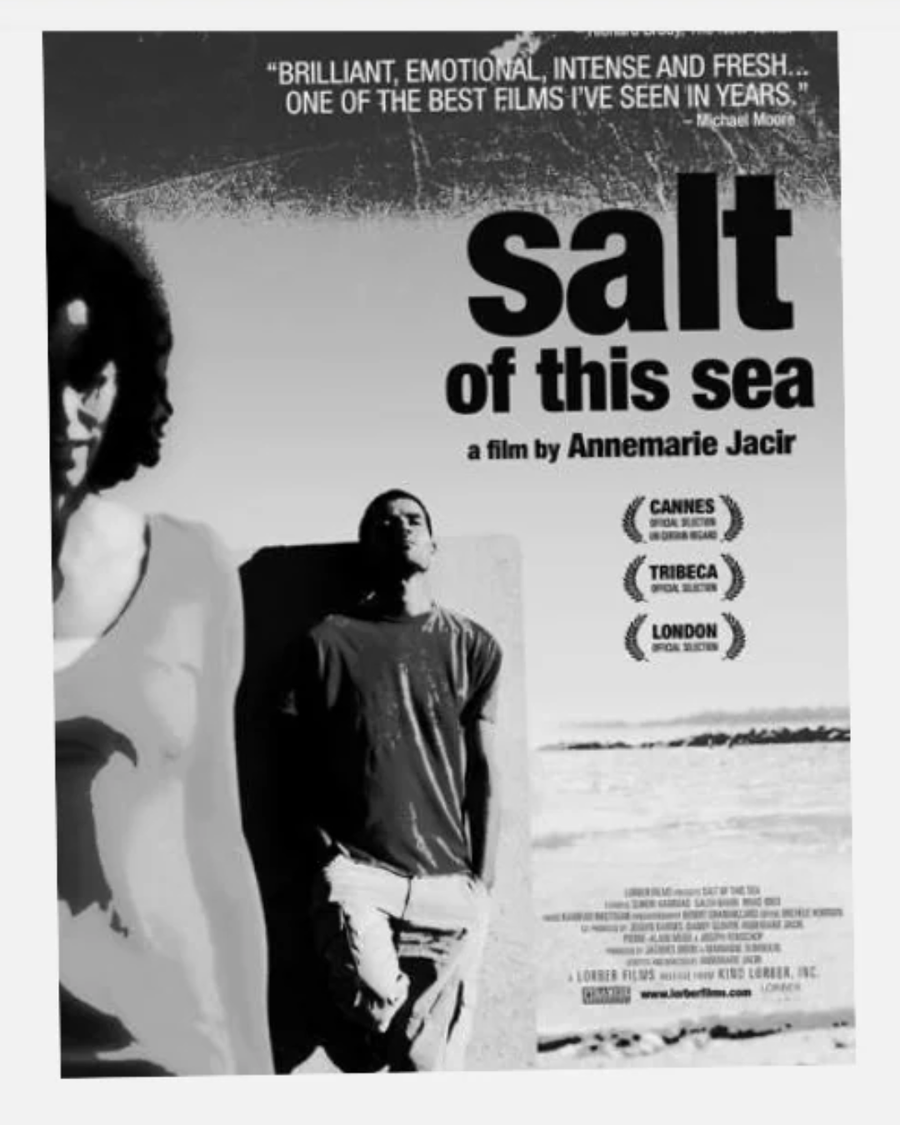
In Salt of this Sea, the desire to return to the homeland becomes a political act of protest against a legal and military system that prevents the refugee, Reem, from reclaiming her family's home or even remaining in the country.
The desire to return is not framed as mere longing, but as a rejection of a necropolitical system that excludes the Palestinian from their right to the place, and regulating absence through laws, borders, and memos.
The Palestinian body here is not an object of pity but a desiring subject, charged with memory, that refuses to have its existence reduced to a colonial legal text that dictates who has the right to live within the land and who is to be exiled from it.
This fuels the unfulfilled desiring connection between the film's two main characters, drawing the audience in to become a witness to its absence, precisely because of the intensity of its presence.
WHEN I SAW YOU (2012)
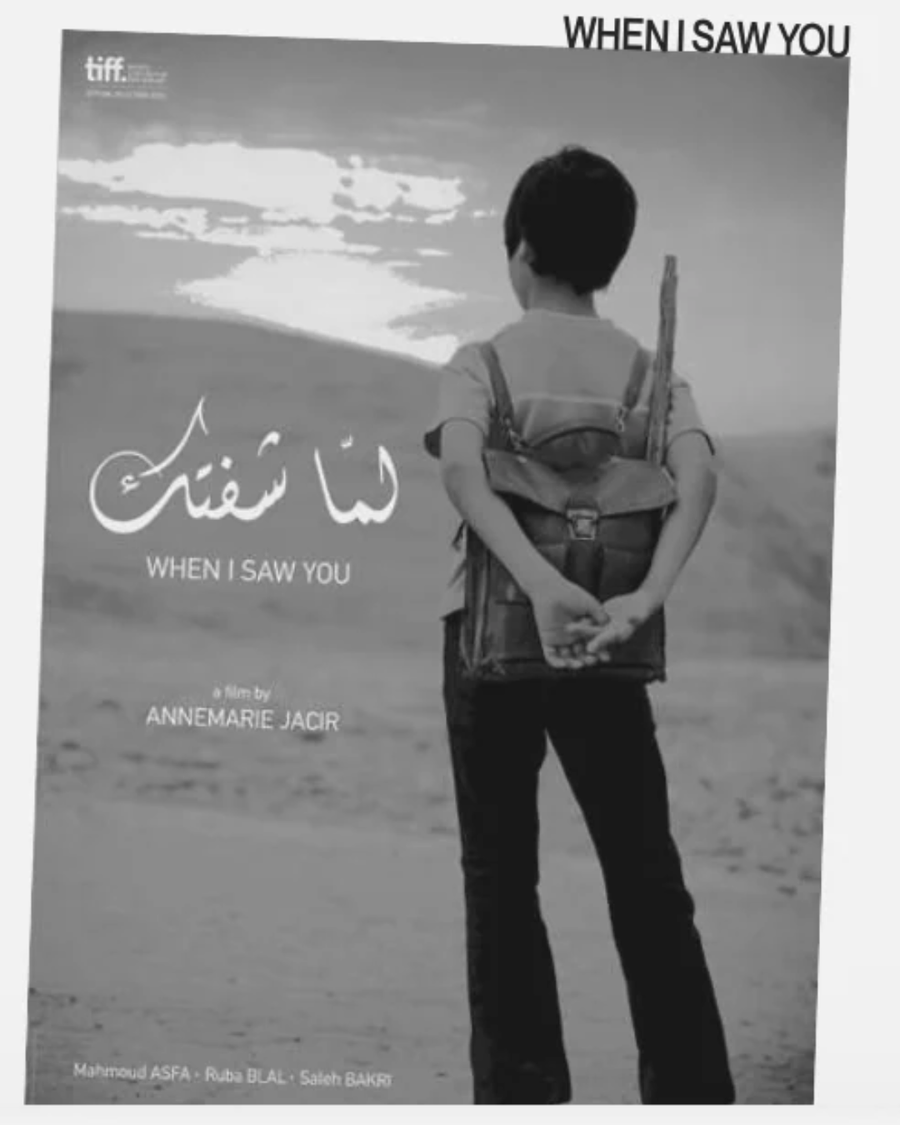
In When I Saw You, desire transforms into bursting energy through the character of the child Tarek, who flees a refugee camp to reach the fedayeen camp in search of freedom and belonging.
In this case, desire is repositioned not just in returning, but also in transcending the state of waiting – both in waiting to come of age and join the fedayeen, and in waiting for a realized sense of masculinity that manifests in his relationship with his mother.
Waiting is temporal in nature, but here, desire drives the breaking of the suspended time imposed by international relief organizations and refugee camps as necropolitical tools to manage suspended existence.
The child doesn’t want to be a passive object but an active subject, rebelling against the confined spaces presented as protection, but which are, in truth, another form of perpetuating slow death.
His fleeing to the fedayeen camp is not so much an escape as it is a desire to shape a future beyond the logic of pacification and domestication.
Through these three examples, desire in Palestinian cinema emerges as a site for dismantling necropolitics.
It does not appear as merely romantic nor individual, but rather as a discourse that defies how the occupation manages death.
The characters’ determination to fulfill their desires – whether for love, return, or liberation – is in itself an act of resistance against an authority that seeks to restrict Palestinian life within the limits of manageability.
Desire here isn’t just about survival but about reclaiming life as a horizon of sovereignty and dignity, in the face of a system that tries to empty life of its potentials and render it bare, submissive, and meaningless.
In this sense, desire, at the heart of siege, is a way to restore the legitimacy of Palestinian existence, not only in terms of law, but also in terms of the body, time, language, and cinema.
AMIRA
In Amira, the Palestinian body becomes a field for both biological and political struggle, as repression is not limited to siege or killing, but penetrates into matters of birth, lineage, and identity – the foundations of human existence – and the unconscious of desire, whether in relation to self-recognition or its denial.
The story tells of a Palestinian girl born from sperm smuggled from her imprisoned father, only to discover later that the occupation manipulated the sperm, and that her biological father was not a Palestinian prisoner, but an Israeli soldier.
Here, the features of necropolitics become starkly evident as a form of control that not only decides who gets to live and who must die, but that also produces the conditions for life that are essentially unlivable. [17]
In this context, the Palestinian isn’t just physically killed, but is deprived of sovereignty over their descent, lineage, and right to know “who they are.”
In one way or another, this is the objective equivalent of historical existence.
Desire in Amira isn’t only romantic or existential, but takes on a sovereign form: a desire for belonging, for fatherhood, and for symbolic continuity amid rupture.
The mother, through her choice to be inseminated with smuggled sperm, performs an act of resistance, but the occupation succeeds in obstructing this very desire, reconstituting it as a tool of domination – one that fragments the boundaries of the body without even touching it.
The mother, of course, did not desire the soldier, nor did he have intercourse or any physical relationship with her.
The Palestinians' desire to reproduce the self is transformed into a space contaminated by colonial domination, where the origin of life becomes subject to manipulation and lineage is redefined as a political weapon.
Thus, necropolitics exceeds the boundaries of the body and reaches into the genetic structure, making the Palestinian body into a colonial text open to doubt.
But the dilemma becomes even more complex when considering the Palestinian reaction to the film, as the work was met with widespread refusal.
The filmmakers were accused of betrayal — and some even called for a boycott of their work — because many Palestinians saw the film as casting doubt on the symbolism of prisoners and compromising the dignity of “smuggled sperms,” which is considered one of the most resistant forms of reproduction.
This attitude shouldn’t be understood merely as a defense of the prisoners, for it reveals a deep tension within the politics of the national collective, particularly regarding the relationship between desire, patriarchy, and the female body.
This uproar also reveals a patriarchal nationalist logic that reproduces control over the female body by treating it as a symbol of collective identity rather than a sovereign self.
When the sperm becomes a site of suspicion, the female desire to have children becomes uncertain and subject to political scrutiny, as if the female body has no right to sin or be penetrated, because it belongs to the group.
This brings to mind Judith Butler’s concept of “grievable life,” wherein those who do not belong to the dominant narrative of a group are not considered grievable, but rather symbolically exiled. [18]
Thus, Amira not only exposes necropolitics as a colonial power, but also reveals the necropolitics internal to the Palestinian nationalist context, where the collective itself produces forms of exclusion and oppression when its male narrative is threatened.
Instead of generating resistance, desire becomes a source of political anxiety, for it exposes the structure from within.
In this way, the female body – which is supposed to be a medium for the reproduction of the collective – becomes an object of suspicion and a source of danger, burdened with the task of preserving symbolic and national purity, even when the desire stems from an act of resistance.
Ultimately, Amira exposes the boundaries of the group from within by revealing how the occupation controls the land, prison, and body, and also creates fragility within the very narratives of national sovereignty by penetrating the most intimate sites: desire, motherhood, and lineage.
CONCLUSION
Palestinian cinema transforms desire into a radical act of resistance, where the intimate intertwines with the political, the body with discourse, and the geographical with historical meaning.
From the dead political body in Paradise Now, to the feminist, class, and urban challenge in Rana’s Wedding, to the anti-colonial imagination in Suleiman’s It Must Be Heaven, these films confront erasure and narrate personal and collective agency and meaning amid structural and colonial violence.
Desire here is not an isolated internal emotion, nor a consciousness that grows in darkness or individuality. Rather, it’s a political and social weapon that shapes the rules for presence – visually and existentially – against colonial erasure.
The politics of desire in Palestinian cinema dismantle multiple layers: from longing for the homeland and freedom, to the struggle to reclaim the narrative, to the negotiation of personal and national identities, and finally to having hope for futures that transcend trauma and displacement.
They emerge from the geographic body, or the body rooted in the land. Such desires are not presented as a negative material for the gaze, but as a layer of meaning and place, performed through the very act of filmmaking, which has become a visual and political resistance.
Palestinian cinema shows that desire is neither purely personal nor purely political, but lies at the intersection of the intimate and the collective, the individual and the historical, the mundane and the mythical.
Through their films, Palestinian directors transform desire into a sovereign act that challenges erasure, affirming existence, and reimagines what Palestinian existence can be.
As Hamid Dabashi argues in Dreams of a Nation (2006), Palestinian cinema does not treat trauma as a past to be overcome, but produces itself in the midst of ongoing trauma, resisting it through artistic creation. [19]
This ongoing state of exception and confrontation ensures that the politics of desire in Palestinian cinema remain vital, dynamic, and fundamentally connected to the Palestinian struggle for liberation and self-determination through self-criticism and criticism of the colonial other, without being trapped within a barren modern binary.
In representing desire – as incomplete, deferred, and urgent – Palestinian cinema expresses in the strongest terms a liberating vision, one that challenges the reduction of the Palestinian to a past state or a post-Nakba human being and insists on drawing the horizon of “the liberation to come.”
References
[1] Nurith Gertz and George Khleifi, Palestinian Cinema: Landscape, Trauma, and Memory (Bloomington: Indiana University Press, 2008).
[2] Institute of Contemporary Arts, “Art For The Struggle, Struggle For The Art,” SAFAR Film Program.
[3] Foulquié, Paul, Dictionnaire de la langue philosophique, 6th ed. (Paris: PUF, 1992): 162.
[4] Catherine Clément, Psychoanalysis, trans. Muhammad Sabila (Casablanca: Al-Zaman Publications, 2000): 31.
[5] Ibid, p. 32.
[6] Ibid, p. 15.
[7] Ibid, p. 34.
[8] Nurith Gertz and George Khleifi, Palestinian Cinema: Landscape, Trauma, and Memory (Bloomington: Indiana University Press, 2008).
[9] Sanabel Abdelrahman, “Approaches to Palestinian Liberation: Magical Realism as Resistance Literature,” NO NIIN, May 2023.
[10] Badr Al-Aqabani, “Palestinian Cinema: A Journey to Find the Archive and the Lost Paradise,” The New Arab, November 21, 2023; Ibrahim Darwish, “Palestinian Cinema: Stages in the Search for Collective Identity and Multiple Narratives, and within the Story of a Lost Archive Erased by Wars and Rumors,” Arab48, October 31, 2010.
[11] John Menick, “The Occupied Imagination of Elia Suleiman,” September 11, 2010.
[12] Homi Bhabha, The Location of Culture, London: Routledge Press, 1994, p. 36.
[13] Sarah Dennis, “Young Women in Khleifi’s Wedding in Galilee,” Arab, Cinema, Culture, September 28, 2014.
[14] “Rana’s Wedding,” Vern’s Reviews on the Films of Cinema, March 13, 2024.
[15] Roger Ebert, “Rana’s Wedding,” RogerEbert.com, January 30, 2004.
[16] Achille Mbembe, “Necropolitics,” Public Culture 15, no. 1 (2003): 11.
[17] Mbembe, Necropolitics.
[18] Judith Butler, Frames of War: When is Life Grievable? (London: Verso, 2009), 1–34.
[19] Hamid Dabashi, Dreams of a Nation: On Palestinian Cinema (London: Verso, 2006), p. 16.
Related publications
Research Papers · 2024
Palestinian Space in the Time of Genocide: Introduction to a Spatial Resistance to Colonialism, War, and Genocide
This introduction, written as a conceptual entry to the file of Issue 140 of the Journal of Palestine Studies titled "Land, Human and Place in Genocide," examines representations of the concept of colonized space in Palestine, encompassing indigenous geography and existence, from literature and symbol to infrastructure and history.
Research Papers · 2024
Resili[stan]ce: Politics of Exile and Decolonizing Space/Design (A Deleuzian Approach)
A concept note for the Eye on Palestine Program – International Summer School, developed for the Arab American University & The New School - New York University, 2024. Examines the politics of exile and decolonizing space/design through a Deleuzian philosophical framework.
Research Papers · 2024
Where Does Urbicide Begin? A Comparative Introduction to Spatial Erasure Policies in the Israeli Occupation System, Ending in Gaza
Starting from the reality of the Israeli genocide war in Gaza (2023–), this paper investigates the modern roots of the city and the modern war machine, presenting the concept of Territory as a fundamental tool for building the colonial condition, specifically the modern city. Comparing urban and planning policies in Jaffa and Beer Sheba with Gaza at war, it proposes a conceptualization of urbicide in the colonial system, arguing that ongoing genocide mirrors the ongoing Nakba as a spatial policy of negating Palestinians.