 LectureStanford UniversitySpatial PoliticsWar and GenocideFROM THE SKY TO THE UNDERGROUND: Colonial Spatial Warfare and Palestinian Counter-GeographiesThis lecture examines Gaza as a paradigmatic site of contemporary colonial spatial warfare, arguing that Israeli settler colonial violence operates not merely through military occupation or episodic destruction, but through the volumetric reorganization of territory itself. The talk introduces the concept of "territorialized genocide" to describe a mode of elimination enacted through the production, fragmentation, regulation, and destruction of space. Drawing on critical geography, settler colonial studies, urban theory, and Black geographies, the lecture theorizes Gaza as a volumetric battlefield structured across three interconnected spatial registers: the militarized sky, the fragmented urban surface, and the politicized underground.
 PodcastAl Sharq PodcastSpatial PoliticsPolitics and RevolutionHow were our Arab cities crushed? From the Arab Spring to the extermination in GazaWhat makes a city more than just its built environment? How do bridges and public squares transform into a political language in certain nations?
 Research paperInstitute for Palestine StudiesMemoryLiteratureHow Do We Add Zero?Written about Elias Khoury at his incomplete departure from us, published in the Journal of Palestine Studies, Issue 141, Winter 2025. Also written on the margins of a research project titled "On Death Suspended in Space," an attempt to produce a spatially and narratively composite map of Beirut based on the materiality of everyday thought as described by Mahdi Amel.
 LectureMada al-Carmel · Urban Studies FoundationSpatial PoliticsColonialismSuspended Urbanism in Settler Colonialism: Planning as UrbicideThis lecture examines "urbicide" not only as physical destruction but as a systematic colonial strategy enacted through urban planning and structural exclusion. Drawing on case studies from Gaza, Jaffa, and the West Bank, the discussion conceptualizes the "suspended city"—a space where modernity, accumulation, mobility, and sovereignty are actively obstructed. The talk engages decolonial urban theory to interrogate spatial violence and to imagine counter-urban narratives and agencies.
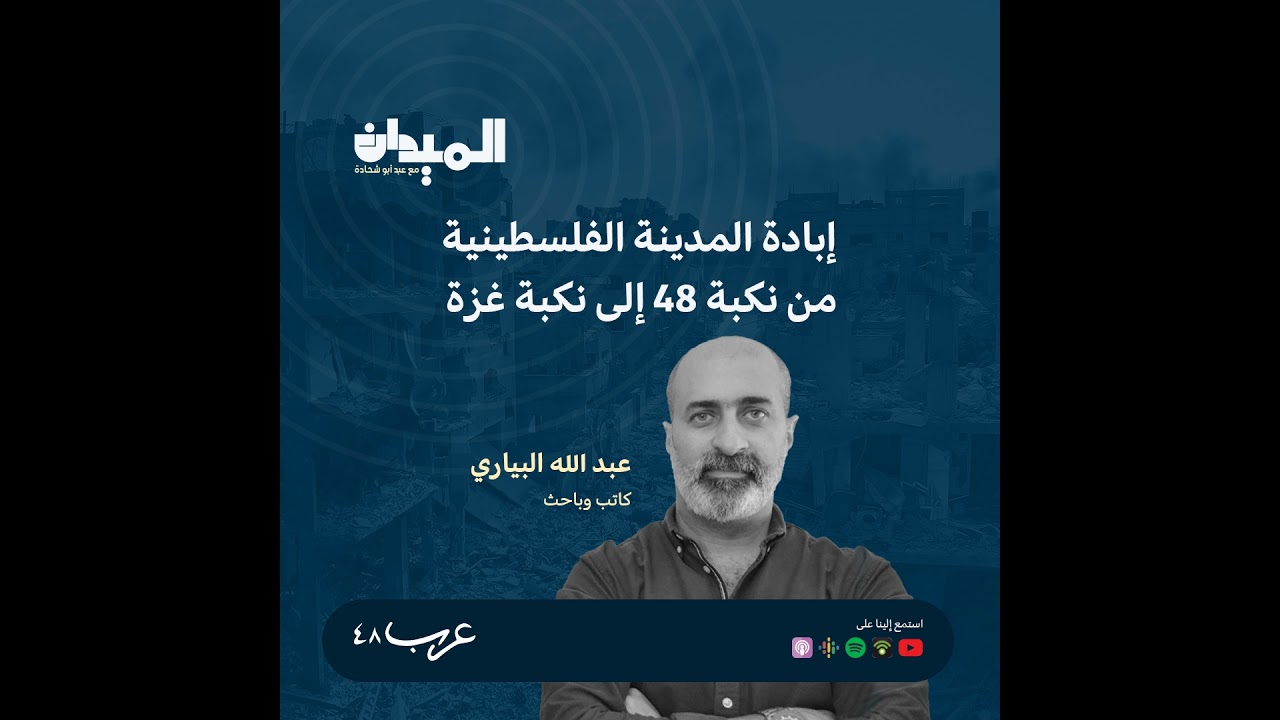 PodcastArab 48War and GenocideSpatial PoliticsThe Destruction of the Palestinian City: From the 1948 Nakba to the Nakba of GazaIn this episode of Al-Maidan on Arab48, researcher Abdalla Bayyari discusses the Palestinian city, from the 1948 Nakba to Gaza, in the context of the transformations that have shaped Palestinian cities and urban spaces.
 Research paperInstitute for Palestine StudiesSpatial PoliticsWar and GenocidePalestinian Space in the Time of Genocide: Introduction to a Spatial Resistance to Colonialism, War, and GenocideThis introduction, written as a conceptual entry to the file of Issue 140 of the Journal of Palestine Studies titled "Land, Human and Place in Genocide," examines representations of the concept of colonized space in Palestine, encompassing indigenous geography and existence, from literature and symbol to infrastructure and history.
 Research paperEdafatWar and GenocideSpatial PoliticsWhere Does Urbicide Begin? A Comparative Introduction to Spatial Erasure Policies in the Israeli Occupation System, Ending in GazaStarting from the reality of the Israeli genocide war in Gaza (2023–), this paper investigates the modern roots of the city and the modern war machine, presenting the concept of Territory as a fundamental tool for building the colonial condition, specifically the modern city. Comparing urban and planning policies in Jaffa and Beer Sheba with Gaza at war, it proposes a conceptualization of urbicide in the colonial system, arguing that ongoing genocide mirrors the ongoing Nakba as a spatial policy of negating Palestinians.